
How Sarah Webster won South Downs Way 100
And her rapid transition from road runner to British trail running champion

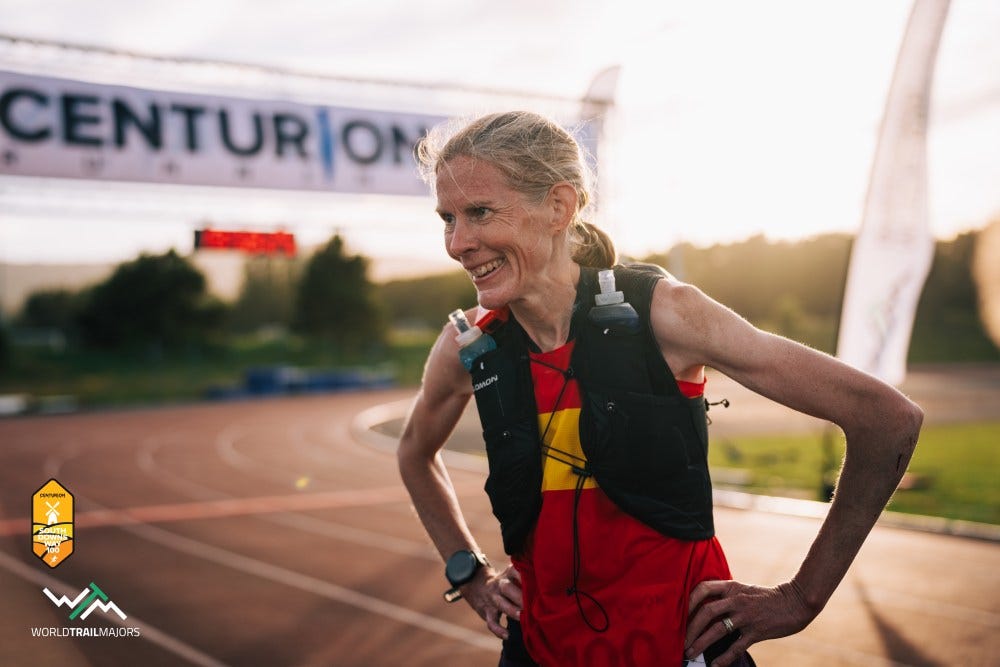
This week I caught up with Sarah Webster after we’d both finished the South Downs Way 100. We were chatting during the middle of the heatwave and, before we even got onto running, we spent a few minutes laughing about how hopeless our dogs were in the hot weather.
While my dog kept wandering into the conservatory despite it being like an oven, Sarah’s had decided the best solution was to sit on her pillow and pant in her ear.
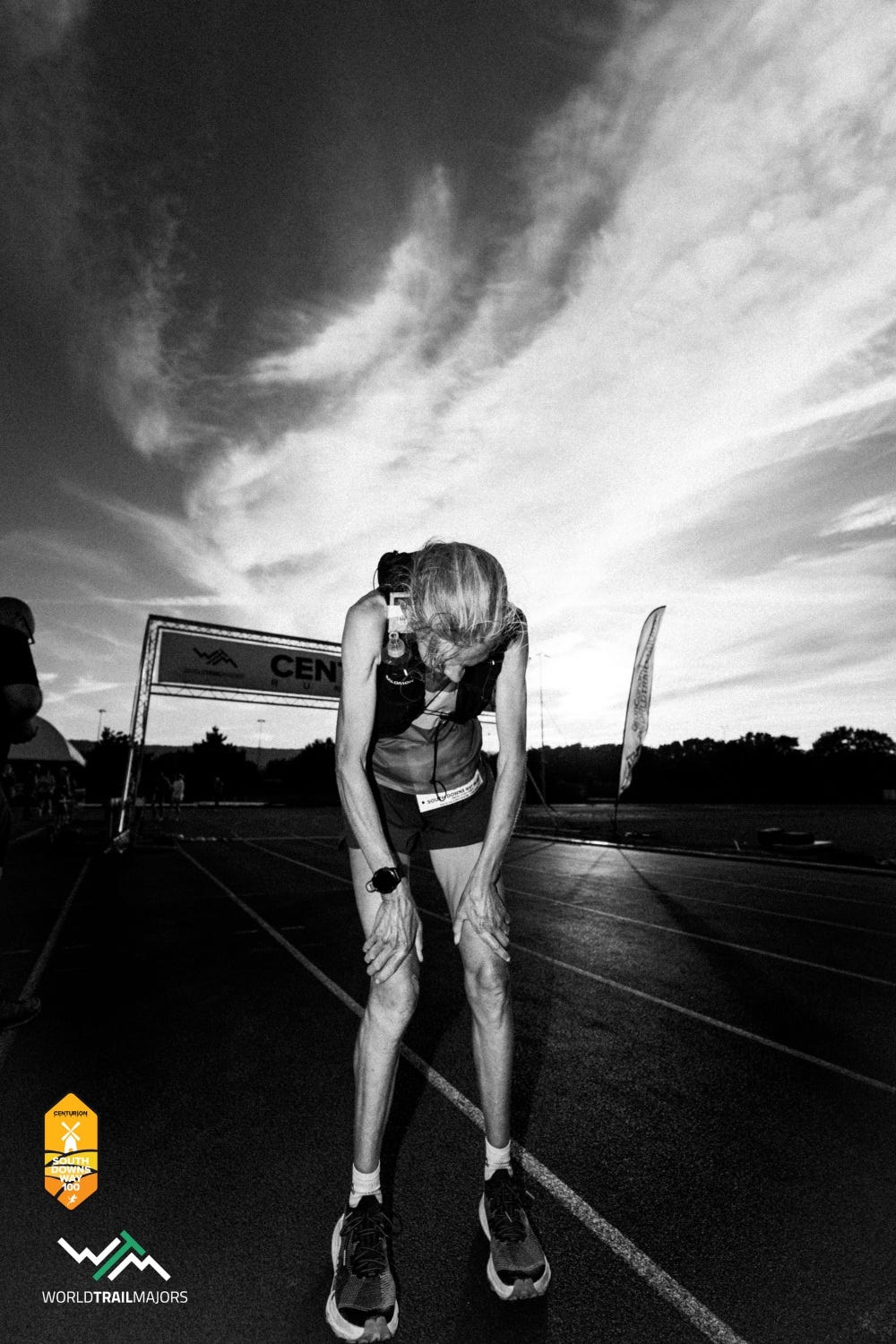
Our races on the other hand couldn’t have been more different. I completed the South Downs Way 100 - my first 100 miler - in just over 27 hours. Sarah covered exactly the same course in almost half that time, smashing the women’s course record in 14:27:34, placing first female, sixth overall, and becoming British trail running champion in the process.
Remarkably, Sarah is still relatively new to trail running. Better known as one of Britain’s top road ultra runners, she already holds the 24-hour world championship record. Now she’s proving she can mix it with the best on the trails too.
Here’s what she had to say.
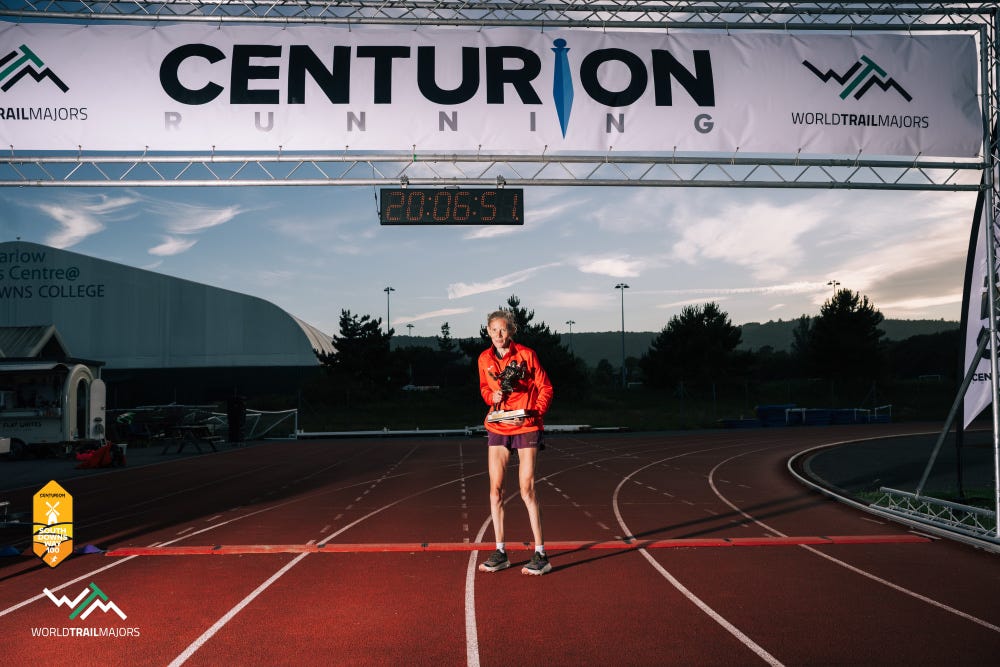
How did you prepare for the South Downs Way 100?
I did generally more trail running and more mileage than I did for the 100km (Ultra Conero 100km in Italy, where she ran 7:03:48 in February and won the women’s race). I was doing about the same mileage as for the 24 hours (IAU 24-Hour World Championships in Albi, France, where she ran 278.622km last October) and set the women’s world record, around 135 miles a week, but it was mostly faster and obviously with lots on trails.
I combined a dog walk and run two or three mornings a week, running up Seaford Golf Course, along the cliffs and back down. It wasn’t difficult trail running but it got my legs thinking about uneven ground and practising the descents.
I also started running to work and back rather than driving. It’s 6.8 miles each way and it meant more time on my feet. Then on Thursdays I’d run home the long way around 13 to 14 miles, getting onto the South Downs and practising the descents.
My long runs were three to four hours at the weekend, done by time rather than distance, and I still kept one speed session and one marathon pace session every week.
I think I had a massive home advantage. The last third of the course is basically my training ground every weekend. I’ve done hill reps on the hills outside Seaford and pretty much every off-road run for the last year has been up there somewhere.
I also recced the course from Amberley onwards because I thought, if I know that section really well, I’ve got no excuse.
How did the race unfold?
The first quarter was pretty good. I was really conscious that I didn’t want to go with the front group because I knew they were going to go off faster than me.
Then between Queen Elizabeth Country Park and Washington I definitely went a bit too fast. I floated down to about 7.30 mile pace when really I should have stayed closer to 7.50. I think if I’d done that I probably wouldn’t have cramped as badly as I did.
By Washington the cramps had started. I had to accept I was going to walk all the hills because otherwise my legs were just going to seize completely.
The third quarter was by far the hardest part of the race. If I hadn’t had my pacer, I probably wouldn’t have done it. But once I got onto my home territory I knew exactly where I was and exactly how long it should take me. That really lifted me mentally. I started to feel stronger again and I could run a bit further up each hill before I had to walk.
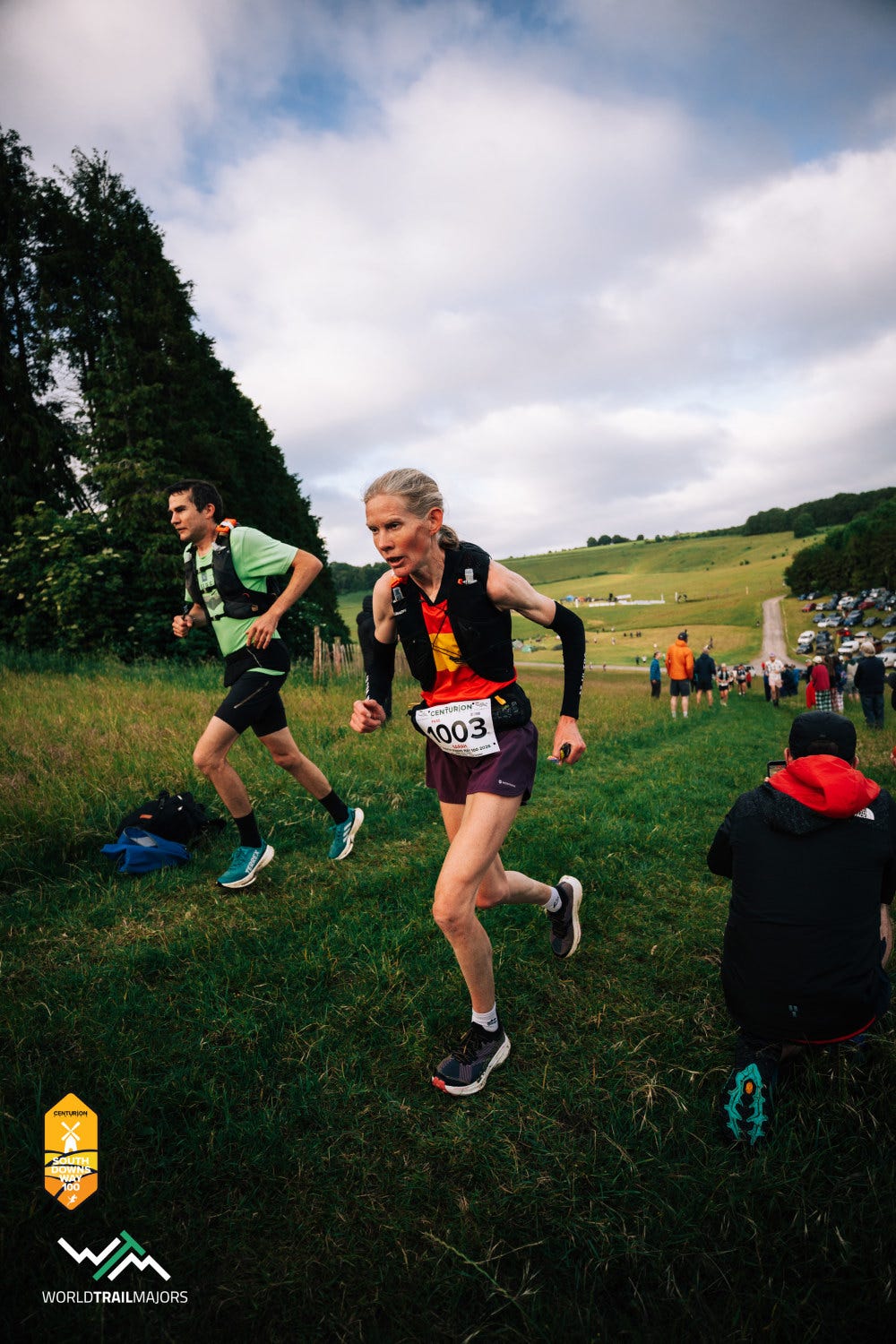
What were the toughest moments?
Alfriston was horrible. That climb was probably the only bit I really struggled with.
Then the descent through the gully was awful. It was so narrow and my legs were so tired I genuinely thought I was going to fall over. If the camera hadn’t been on me I’d probably have just stood there and cried.
I actually only fell once during the race and that was on a fairly flat section. Two lovely trail fairies helped me back up.
How important were your crew and pacers?
They were brilliant. I had crew at pretty much every crew point and they were swapping bottles, handing me gels and doing everything for me. When you come into a checkpoint you’re in a bit of a panic. Having crew means you don’t have to think.
I also had three pacers. George took me from Washington to Clayton Windmills, Flan from Clayton to Firle and Ellen from Firle to the finish.
How did you fuel yourself?
My nutrition plan has actually got simpler and simpler with each race.
I took a Precision Fuel & Hydration gel every half an hour and had three caffeine gels during the race. Later on I had some Coca-Cola as well.
The mistake I made was probably not drinking enough in the first half. I was paranoid about wasting time swapping bottles or stopping for the toilet, so I held back on fluids.
I was also supposed to stop at aid stations and pick up food that I fancied, but I honestly don’t think I even saw the food. I was in such a rush that I just kept moving.
What were you hoping to achieve?
My only real aim was to finish in daylight because I don’t like running in the dark, especially not through that gully.
I thought under 16 hours was realistic and I was hoping for under 15, but I honestly didn’t know if I was capable of it.
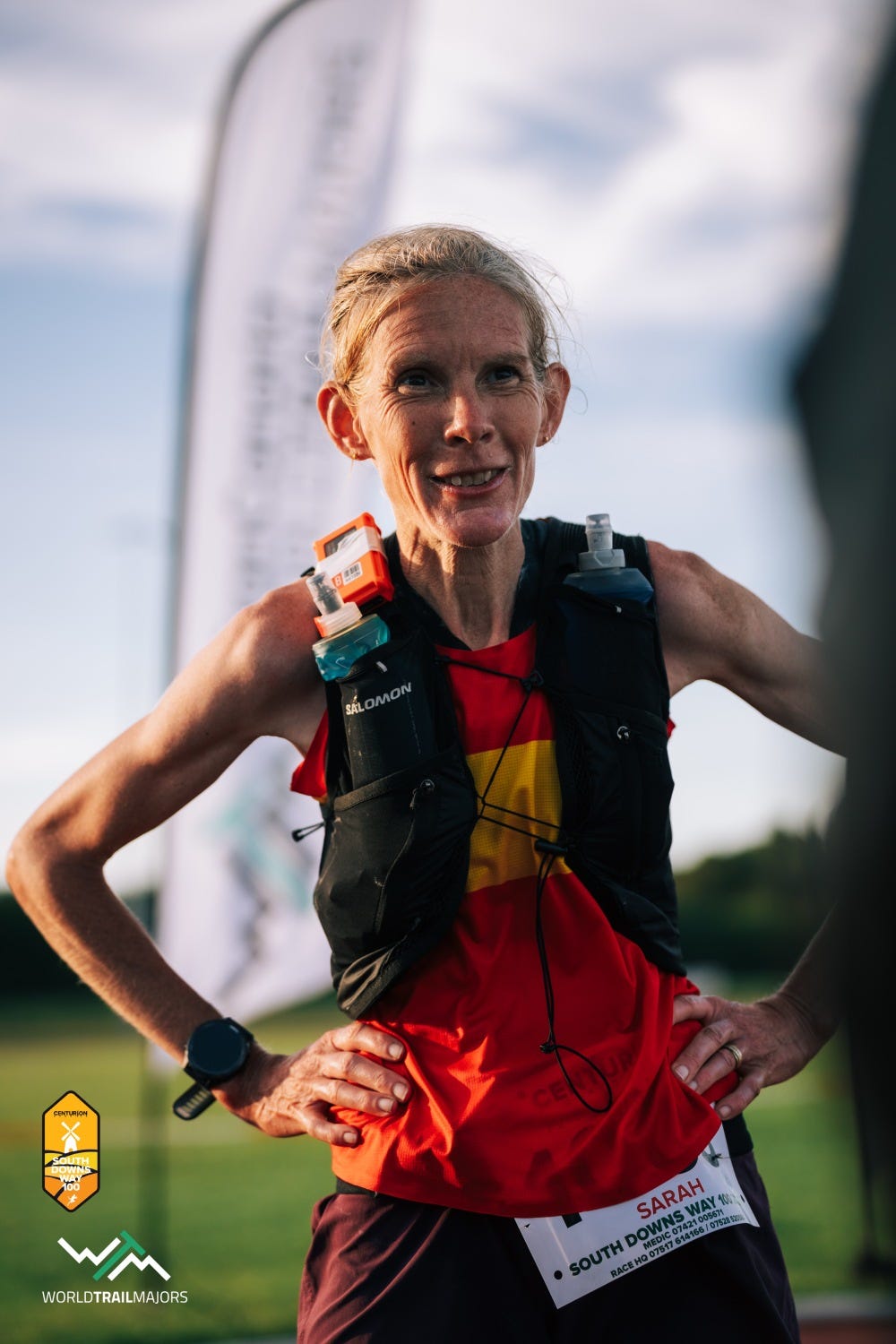
What does breaking the course record mean to you?
Records are there to be broken and hopefully somebody will come along and break mine.
For me, becoming British trail running champion was actually more special. I’m not really a trail runner, so to compete against some very good trail runners and come away with that title was fantastic.
I was very nervous before the race because I didn’t know how I’d compare with genuine trail and mountain runners. It’s nice to know I’ve got some ability off road.
Looking back, would you change anything?
I’d definitely pace the second quarter a bit better. The cramps were probably a combination of going too fast, the heat, not drinking enough, not taking enough electrolytes and maybe not eating enough.
I also forgot to put sun cream on. I remembered about two hours into the race, mentioned it to the crew and then we all forgot about it. So I ended up with burnt shoulders.
What’s next?
The World 100km Championships in Spain are next, then eight weeks later I’m doing the Cape Town 100km, which is part of the World Trail Majors.
I’m very conscious I probably only have another few years at this level. That doesn’t mean I’m going to stop running, but I’d like to race as much as I can while I’m still capable of competing near the front.
There are so many races on my bucket list that I’d rather keep testing myself somewhere new.
Pick of the Week
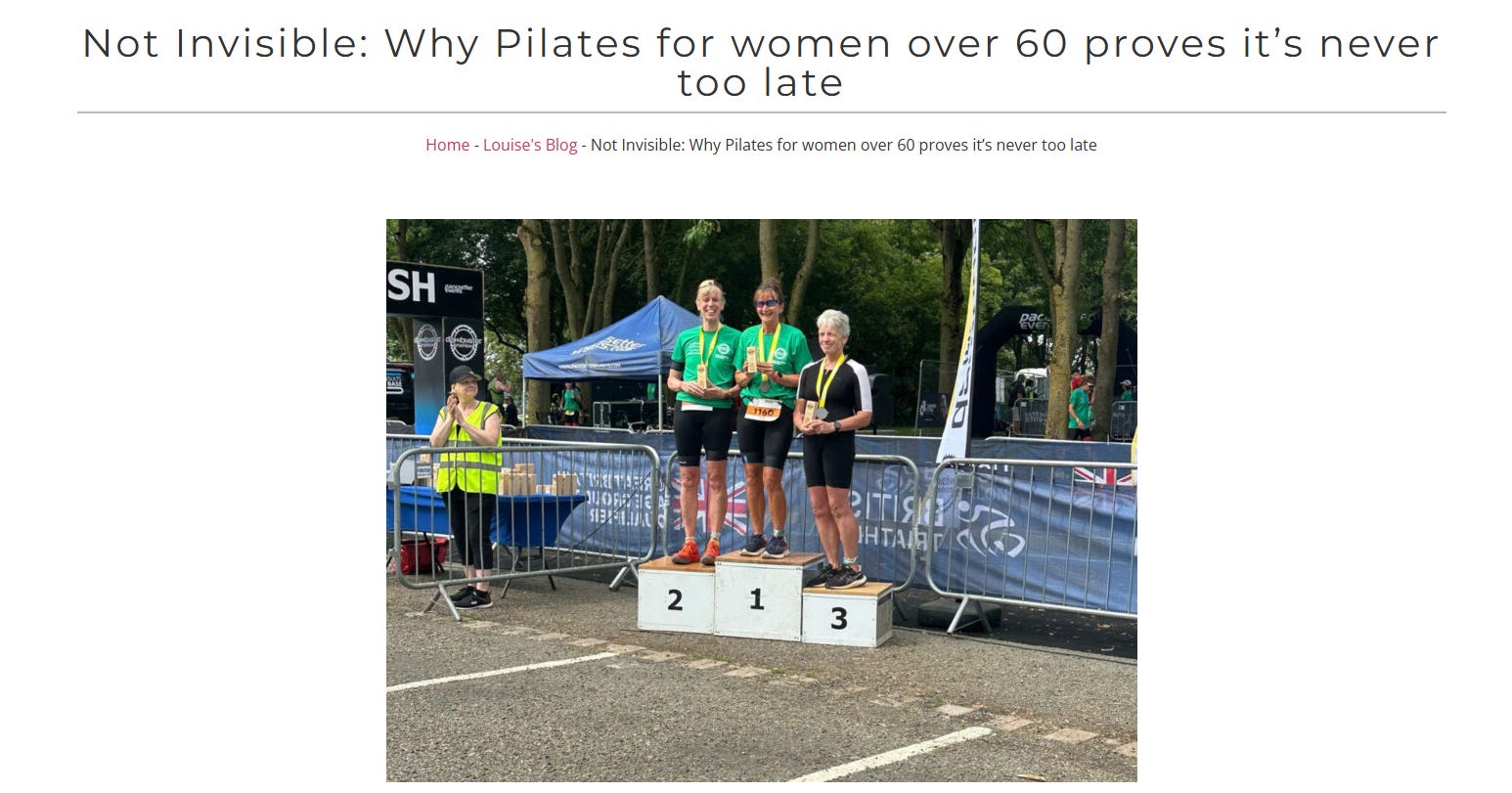
My friend Louise Humphreys podiumed at Dambuster Triathlon last weekend, coming second in her age group. Off the back of this incredible achievement she has written an excellent blog about why women over 60 are not invisible and how it’s never too late to try something new.
It’s an impassioned plea to older women to think big and refuse to hide away. It’s right up my street and I highly recommend reading it, whatever your age!
Louise was the first person to introduce me to canicross (running attached to a dog) and is the reason why I now have an insane dog 🤣 She is an inspiration to so many women and I hope I’m as fit and active as her when I reach my sixties.

Thanks for reading this week’s newsletter. Send feedback to lilycanter@yahoo.co.uk
What an amazing woman! And thank you for sharing Louise’s blog, we’re definitely not invisible 🫥